ShopSCAPE

// ShopSCAPE
Every channel, one set of data — and ready for the buyer who isn’t a person
ShopSCAPE is the enterprise commerce and marketplace platform we built, run and use ourselves every day on a national marketplace — from catalog, promotion engine and OMS through to the data layer and the AI working on top of it.
We did not wire three vendors together and call it a platform. All three layers are one architecture, held by one team.
Runs a national marketplace on this same codebase · dSURE Software mark from depa · Agentic commerce in use, not on a roadmap · Google Cloud certified implementation partner
Talk to our team See how we implement it
Reply within 1 business day. No obligation, no sales pressure.

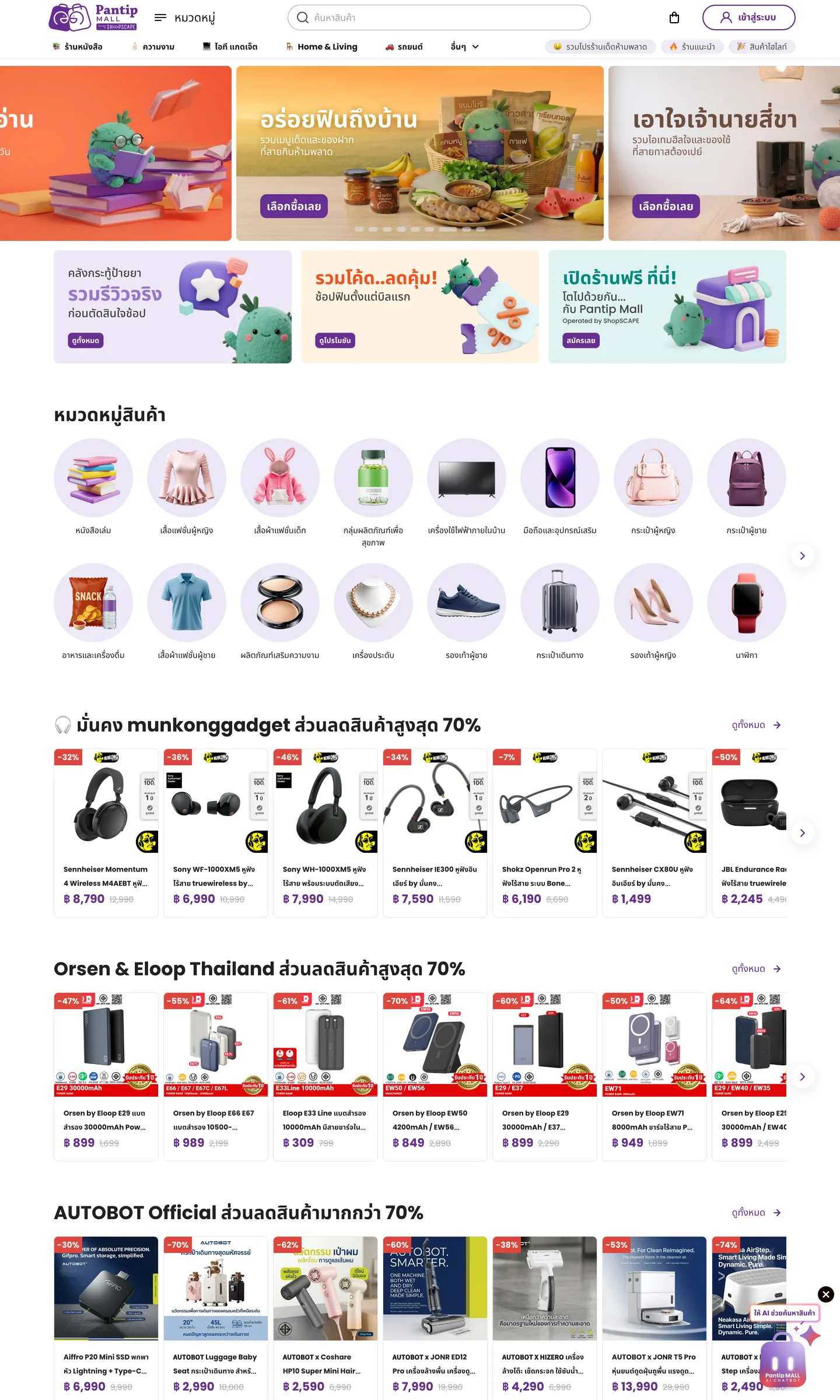
- มาร์เก็ตเพลสหลายผู้ขาย
- ระบบสมัครรับผู้ขาย
- ระบบคอมมิชชั่นและการจ่ายเงิน
- กำกับคุณภาพสินค้า
- ศูนย์จัดการและรายงานผู้ขาย
- รองรับสินค้าหลายรูปแบบ
- จัดการแคตตาล็อก
- ระบบขายส่งสินค้า
- เครื่องมือโปรโมชั่น
- โค้ดส่วนลดและคูปอง
- โปรโมชั่น Flash Sales
- ระบบจัดการคอนเทนต์
- ระบบการจัดการคำสั่งซื้อ
- สต็อกก้อนเดียว กัน
- ชำระเงินไทย และตปท.
- จัดการขนส่งและใบปะหน้า
- เชื่อม ERP และคลังสินค้า
- สิทธิ์ผู้ใช้และระดับแอดมิน
- รองรับการขายผ่าน ผู้ช่วย AI
- Multi-Seller Marketplace
- Seller Onboarding
- Commission & Settlement
- Catalog Governance
- Seller Portal & Reports
- Multi-Format Products
- Catalog Management
- Wholesale Pricing
- Promotion Engine
- Coupon & Voucher
- Flash Sale & Bundle Deal
- Content CMS
- Order Management (OMS)
- Single-Source Inventory
- Thai Payments
- Logistics & Shipping Labels
- ERP & WMS Integration
- Roles & Permissions
- Agentic Commerce Ready
Empowering SMEs and enterprises with tailored features.
A complete platform, whatever the size of the business. Small, mid-market or enterprise — step into modern retail on ShopSCAPE, the Thai commerce platform built so your business understands the buyer rather than guesses at them.
// Why large brands stall
Your complexity is what off-the-shelf calls an exception.
The bigger the business, the less its commercial model looks like anyone else’s — and that is exactly the point where a packaged platform starts saying no.
-
Your commercial rules aren’t on the menu
Channel-specific pricing, discounts stacked on promotions, membership conditions, supplier deals — the things your business actually makes margin on are usually the one thing the platform will not model.
-
A marketplace is not a bigger shop
Seller onboarding, commission structures, settlement, dispute handling and catalog quality are a different problem from a storefront. They are not a module you bolt on afterwards.
-
Customer data lives in six places and none of them agree
The sales system keeps one version, the marketing tools another, the CRM a third. You find out the foundation was never there on the day you try to build personalisation or AI on top of it.
-
The site is ready; the system isn’t readable by AI
Buyers now ask an assistant before they open a browser. If your catalog, stock and prices have no real-time route for an agent to read, you were never in the answer to begin with.
// What ShopSCAPE is
Three layers, one architecture, one team holding it.
ShopSCAPE exists because the platforms on the market at the time could not run the commerce we had to run ourselves — many sellers, real settlement, Thai payment and logistics, and pricing rules that change by channel. Today it is in continuous production with a marketplace on top of it, and our own team hits every problem before a customer does.
| Layer | What it is | Why it matters to a brand |
|---|---|---|
 1 · Commerce Core 1 · Commerce Core | Catalog, checkout, payment, promotion engine, CMS, user permissions and admin tiers | The engine bends to your commercial rules instead of asking you to bend to it |
 2 · Data Foundation 2 · Data Foundation | Events and customer behaviour flow out as usable datasets, wired to your CDP, warehouse and BI | Without this layer every AI above it is guessing. We hold that the foundation comes first |
 3 · Intelligence & Martech 3 · Intelligence & Martech | OMS, Studio, Customer Service AI, Affiliate, Agentic Commerce | The layer that turns data into revenue and turns repeated work into automated work |
The rule we do not break: every order from every channel passes through OMS and decrements stock at a single point before it is confirmed. There is no shortcut around it. That is the mechanism that stops overselling, and the reason channels can be added without the system falling over.
// Layer 1
A commerce engine that takes your complexity on day one.
Marketplace and multi-seller
| Capability | What it does |
|---|---|
 User groups and admin tiers User groups and admin tiers | Split users into groups with different rights — a sales manager sees only order management, the content team sees products and blog, the design team sees only the storefront layer |
 Seller onboarding and settlement Seller onboarding and settlement | Seller onboarding, commission structures, payouts, catalog quality control, and the day-to-day tooling a marketplace team actually works in |
 Multiple product formats Multiple product formats | Physical goods, digital goods and event tickets on one system — no second platform per product type |
 A CMS the content team can use A CMS the content team can use | Admins and sellers write their own content and product detail, with formatting, images, video and custom HTML, without opening a ticket with engineering |
Promotion engine
Discounts are where most platforms run out of road. Ours is built so both the operator and the sellers create promotions themselves, without a ticket to engineering.
| Group | Supported |
|---|---|
 Discount codes Discount codes | Product discounts · shipping discounts · discounts on Coin top-up · new-member coupons |
 Basket promotions Basket promotions | Bundle deals · add-on deals · conditional discounts you define |
 Campaign promotions Campaign promotions | Flash sales · special deals · shipping discounts by basket value |
 Who can create them Who can create them | Both the operator and sellers, each with their own conditions and scheduling windows |
Why this section runs long: every deal your team can think of but the system cannot execute is revenue leaving quietly, every month.
Thai and enterprise integrations
| Area | What it covers |
|---|---|
 Thai payment, logistics and tax Thai payment, logistics and tax | What a business here needs every day, and what a foreign platform treats as a special case |
 ERP, WMS and CRM ERP, WMS and CRM | OMS is the junction out to the warehouse and the back office, including shipping labels and carrier integration |
 Many channels, one pool of stock Many channels, one pool of stock | Orders from every channel land in OMS and decrement one warehouse, with buffer stock and reporting that agrees across the system |
// Layer 2
AI that works starts at trustworthy data, not at a model.
Most failed AI projects in commerce did not fail at the model. They failed because nobody could say which set of records “this customer” refers to. ShopSCAPE treats the data layer as something that exists from day one, not a project that arrives later.
| Capability | What it does |
|---|---|
 Customer and behavioural data Customer and behavioural data | Views, searches, baskets and orders are captured as structured events, ready to be passed on |
 Wired to your CDP and warehouse Wired to your CDP and warehouse | Data flows out to your enterprise data layer and back in as segments and audiences the storefront can act on — see Data Platform, Analytics & CDP |
 One view of orders and stock One view of orders and stock | OMS is the single source of truth for orders and inventory. Every module above reads from it, so there is no silo to reconcile |
 PDPA by design PDPA by design | Access rights, retention and onward transfer of personal data are designed into the system, not bolted on when someone audits it |
// Layer 3
Five modules sitting on the same set of data.
| Module | What it does for a brand |
|---|---|
| OMS — Order Management | Consolidates orders from every channel, decrements stock at one point, prevents overselling, controls buffer stock, and connects the warehouse to the carriers |
 Studio — Content & Campaign Studio — Content & Campaign | The production centre for content and campaigns, with GenAI tooling for the asset work that has to be repeated at volume |
 Customer Service AI Customer Service AI | A RAG assistant grounded in the real catalog, order status and knowledge base, with a persona and an SLA you define |
| Affiliate & KOL | Link and code attribution, commission calculation and payout, for KOLs, creators and general affiliates |
 Search & Personalisation Search & Personalisation | Search that reads buyer intent, product recommendations, and per-person merchandising that runs on real data rather than fixed rules |
Every module shares catalog, checkout and payment with the Commerce Core through one contract. We do not build the same thing twice, and you never synchronise your own systems against each other.
⟦Confirm which of these five are in production today. Our own roadmap has OMS ahead of Studio, Customer Service AI and Affiliate — any module that has not shipped comes off this table before publication, rather than being described in language broad enough to cover both.⟧
// Agentic commerce
When your next buyer is an AI.
Buying is moving into conversation. Customers ask an assistant what to buy, compare prices in a chat, then purchase — and sometimes they are not the one pressing the button. The question for a brand is no longer how to make the site prettier. It is whether your products can be read and bought by an agent at all.
-
Agents read your catalog in real time
Price, stock and product detail are exposed to agents over MCP — not scraped off a page that is already out of date by the time it is read.
-
Several protocols, no single bet
The market has no settled standard: UCP, ACP, MCP and AP2 are still competing. We built an interconnect layer rather than tying your products to any one party’s protocol.
-
A data shape machines can read
Product, offer, price, availability, reviews and return policy are structured for machine reading. That is the minimum condition for appearing in an AI’s answer at all.
-
Agents working the business side too
Not only receiving the buyer’s agent: agents on our side handle the repeated commerce work, from catalog content through to answering sellers and customers.
When agents become a channel, the old metrics start lying. We set up the newer set with you — how often the brand is cited in AI answers, traffic arriving from AI assistants (which lands in Direct by default), and the share of purchases that began with an agent.
⟦State the depth before publication: which protocols are live today, on which storefront, and whether any customer is using it yet. Sales has to answer this in the first meeting — it is the question a competitor will ask.⟧
// Our view
Retail is on its fifth generation, and this one is decided by data.
The frame we use with clients is Ascential’s Five Generations of Retail — from fragmented markets, to large chains, to ecommerce, to algorithm-driven commerce, and now to the fifth: personalisation at mass scale.
What separates the fifth generation is not a better-looking storefront. It is who can genuinely use data at scale, who adapts faster, and who gets the goods to the customer sooner. ShopSCAPE was designed for this generation, not the last one.
| Dimension | Retail 4.0 | Retail 5.0 — where ShopSCAPE stands |
|---|---|---|
| Driven by | Algorithms and customer data | Personalisation at mass scale on large-scale data |
| Channels | O2O, online mixed with offline | Every channel, including the ones where an agent is the buyer |
| Marketing | Data-driven marketing | GenAI at every step, from content through to customer service |
| Speed | Campaign cycles measured in weeks | Adjusts as fast as the data changes |
// Proof
Built it, run it, and live on it.
-
Pantip MALL
A national marketplace we built and run ourselves on ShopSCAPE, with backing from Thailand’s digital economy programme.
⟦Which supporting agency may be named on a public page · and the result figure, with a source its owner has reviewed⟧
-
Reeeed
A content marketplace we built and run ourselves — a different commercial model on the same engineering discipline.
⟦Result figure, with a source its owner has reviewed⟧
-
Enterprise brands
⟦Client name, two-line description and result — held until written consent is on file⟧
We show the work we are allowed to talk about. If a number has not been confirmed by the person who owns it, it does not go on this page.
// Standards and public-sector backing
Assessed by bodies that do not work for us.
Every vendor says their system is secure. The question that actually helps during an evaluation is who assessed it, and against whose criteria. ShopSCAPE has been assessed against criteria set by a Thai government agency, and sits on the register the public sector procures from.
dSURE Software — depa
| Question | Answer |
|---|---|
| What it is | A quality mark for digital products and services, created by the Digital Economy Promotion Agency (depa) to raise the standard of Thai digital goods |
 What is assessed What is assessed | Safety in use, cyber security, and compliance with applicable law including PDPA |
 Who assesses it Who assesses it | Testing bodies inside depa’s accredited network — not a manufacturer’s self-assessment |
| What it means for you | Your procurement and security teams start from a document issued under a Thai government scheme, instead of taking a vendor’s word for it |
⟦Attach the certificate number and its issue and expiry dates, and confirm whether the mark was issued to the product “ShopSCAPE” or to Digithun Worldwide — the page has to say whichever is actually on the certificate⟧
The digital service catalogue — procurable by government
| Question | Answer |
|---|---|
| What it is | The register of Thai digital products and services maintained by the Ministry of Digital Economy and Society together with depa |
| Why it matters | Public bodies can procure from this register through a transparent, auditable process. If your organisation is a state enterprise or has a line that must clear procurement regulations, this is the difference between procurable and not |
 Tax relief for the buyer Tax relief for the buyer | Buyers of digital services on this register may be able to claim a software deduction for productivity investment, subject to the conditions in force. Ask your finance team to check the conditions applying in that tax year |
⟦Confirm that the ShopSCAPE product itself is on the register, not only the company⟧
BDS — support for the SMEs on your platform
| Question | Answer |
|---|---|
| What it is | The Business Development Service measure run by the Office of SME Promotion (OSMEP), under which the state co-pays for business development services for SMEs |
| How ShopSCAPE relates | We have joined the programme, so services covering sales-channel development and SME digitalisation fall inside the scope an operator can apply against |
| Why a marketplace operator should care | If your model has SME sellers or partners, the cost of getting them onto the system is the largest source of friction. This reduces the seller-side cost by the share the state co-pays, so you widen the seller base faster without funding all of it yourself |
| Conditions | The co-payment share and the ceiling depend on company size and on the rules of the measure that year. We will help work out which category your case falls into |
⟦Confirm the legal entity registered as the BDS service provider and the exact service name in the register — SMEs will search for that name, so the page has to match it⟧
A certificate does not make a system better by itself. What it does is shorten the meeting in your procurement room, and let the security and PDPA questions start from a document instead of from zero.
// Operating model
You choose who holds the keyboard.
| Model | What it means |
|---|---|
| Your team runs it | We hand over the system, the runbooks and the training, and your team carries it forward |
| We run it | Day-two operations sit with us — see Managed Cloud & FinOps |
| Run it together | Your team handles the daily work; we hold the platform layer and anything that has to escalate to engineering |
| Which cloud | We are a Google Cloud certified implementation partner, and we deliver across clouds when the workload calls for it |
| Pricing | There is no packaged tier, because no two organisations have the same commercial model. Talk to the team and you get the scope and the price in writing |
⟦Deployment model: SaaS only, private deployment, or both — not for publication until this is settled⟧
// Why ShopSCAPE
The platform is ours, and so is the phone number.
We build on Google Cloud as a certified implementation partner. Multi-cloud through one team is the point: BytePlus and Alibaba Cloud where the workload calls for it.
| Reason | What it means in practice |
|---|---|
| The platform is ours | When your requirement has to be met in the platform itself, that is a decision we make. It is not a ticket queued with an overseas vendor |
| We run it ourselves, nationally | Pantip MALL runs on this codebase. Our own uptime depends on the same thing your business would depend on |
| Commerce, data and AI in one team | The platform, the data layer and the AI above it are built by people who sit together. That is the difference between a personalisation feature and a personalisation system |
| Built from real problems | Everything in this system came from something we hit while running a marketplace, not from a feature list copied off a competitor |
| Assessed under a Thai government scheme | The dSURE Software mark from depa and a place on the digital service catalogue mean your procurement and security teams start from paperwork that already exists |
// Choosing a direction
Packaged, bespoke, or this.
| Global packaged platform | Build it all yourself | ShopSCAPE | |
|---|---|---|---|
| Time to launch | Fast | Slowest | Fast, because the engine already exists |
| Your specific commercial rules | Whatever the menu allows | Anything | Anything, because we can change the platform |
| Multi-seller marketplace | Usually a paid add-on | Build it all | There from the start — it is the problem we were born from |
| Thai payment, logistics, tax | A special case | Build it yourself | Ordinary |
| Data and AI layer | Bought and wired separately | Build it yourself | The same architecture |
| Who fixes it when it breaks | A queue, overseas | Your team | The team that wrote the code |
We will say so plainly if a packaged platform suits your problem better. Selling an organisation more system than it needs costs us as much time as it costs you money.
Frequently asked questions.
Is ShopSCAPE bought as a product, or as a project?
Both, and the most honest answer is that an organisation buys the platform and still has engineering around it, because your commercial model is the part no product supports out of the box. The advantage is that the platform is ours, so that engineering can go deeper than configuration.
Does it handle a marketplace with a large number of sellers?
Yes, and that is where it came from. Pantip MALL is a multi-seller marketplace running on this system — seller onboarding, commissions, settlement and catalog quality control included.
Can it connect to our existing ERP and carriers?
Yes, and integration is most of the work on any commerce project. That is why we start with a fit-gap and an integration inventory. Commerce projects fail on mis-scoped integration more than on every other reason combined.
Can our existing customer and order data move across?
Yes. Migrating catalog, customers and orders is part of the build phase, with a reconciliation step so you can prove for yourself that nothing was lost.
Do we need to start on agentic commerce now?
It depends on whether your customers have started asking an assistant before they buy. The thing to do first is not an AI project — it is getting your catalog, pricing, stock and return policy into a state a machine can read. That work pays for itself even if agents never reach you.
Do we have to use Google Cloud?
Usually yes, because it is where we are strongest and it has a data centre in Thailand. We deliver across clouds when your organisation already has commitments elsewhere.
What about PDPA?
Access rights and personal-data handling are in the system design, not in a document written afterwards. PDPA compliance is one of the dimensions assessed in the dSURE process, and we are happy to walk your legal and security teams through the structure.
What standards has ShopSCAPE been assessed against?
ShopSCAPE carries the dSURE Software mark from the Digital Economy Promotion Agency (depa), a quality screening for digital products against criteria depa sets, covering safety in use, cyber security and compliance with applicable law including PDPA, assessed through testing bodies in depa’s accredited network. We will send the supporting documents to your procurement team.
Can government bodies procure ShopSCAPE?
Yes. Our product is on the digital service catalogue maintained by the Ministry of Digital Economy and Society together with depa, which is the register public bodies can procure from through an auditable process.
Can the SME sellers on our platform use state support?
Where they qualify, yes. We have joined the BDS measure run by the Office of SME Promotion (OSMEP), under which the state co-pays for SME business development services at the share and ceiling set by the measure each year. For a brand opening a marketplace this is a real tool for reducing the cost of getting sellers onto the system. Talk to us about which category your case falls into.
Who looks after it once it is live?
Your team, our team, or both. It is a choice, and it is priced separately from the build.
Bring us the rule no system will do.
A standard demo is rarely useful. Bring the pricing condition, the seller structure or the shipping rule that every platform has told you is impossible, and we will show you what it looks like on ShopSCAPE.
Talk to our team Request a current-state review
| Where most teams go next | Why |
|---|---|
| Commerce Platform | You want to see how a real project runs, from fit-gap to go-live |
| Data Platform, Analytics & CDP | You already know the problem is the data layer, not the storefront |
| Agentic AI & Generative AI | You want agents working beyond commerce as well |


Innovate for the better tomorrow.
// Corporate update
Our
Move
-
Buying the platform and building on it used to be two conversations with two suppliers. It is one conversation now: we resell Google Cloud, Alibaba Cloud and BytePlus, and the same engineers who size the environment stay with it through production support.
For teams already running with us, nothing changes technically — the difference is commercial. Licensing, quota and billing sit with the people who know what the workload actually does.
-
A certified implementation partner works to the cloud provider's published reference architectures. In practice that means your landing zone, IAM model and network layout look like something any Google Cloud engineer can pick up — including the next team you hire.
It also means the review gates are not ours to waive. Where the reference architecture asks for separation of duties or a break-glass path, it gets built.
-
Hospital data arrives in fragments — HIS exports, lab feeds, scanned forms, free-text notes in Thai and English. Before a model sees any of it, someone has to answer where each field came from, who consented to what, and which records must never leave the country.
We build that layer first. It is slower to demo and it is the reason the pilots survive contact with a real ward.
-
Live commerce moves fast enough that the recommendation loop has to close in the same session. That puts the weight on the event pipeline, not the model: what counts as a view, when a cart event lands, how quickly the feature store sees it.
We treat the BytePlus components as a stack to be wired properly rather than a switch to be flipped. The lift comes from the wiring.
-
The site you are reading ships as static HTML, one stylesheet and one script, served by a Node process with a strict content security policy. There is no analytics tag, no font CDN and no tracker.
It is partly a statement of taste and partly a working sample: the same restraint we bring to a client's platform, applied to our own front door.
-
Warehouses fill up faster than they get governed. By the time a model needs a feature, nobody can say which of the four revenue columns is authoritative, and the project stalls in a meeting about definitions.
The fix is unglamorous: contracts on the ingest side, lineage through the transformations, and one owner per domain. Do that and the AI work stops being archaeology.